Every request goes to the provider most likely to answer it well right now.
The router scores each provider continuously on speed, errors, how far behind the chain it is, and whether it is rate-limiting you. The score decides who gets the next request. You set the rules once; the router makes the thousand small decisions a day that your on-call engineer used to make. It works across our providers, yours, or both.
One failure, handled
Provider B falls behind the chain but still says it is in sync. The router sees its newest block stop moving and sends reads to Provider A. This needs a second provider on that chain.
Fails over. A bad answer or a timeout is retried on another provider inside the same time budget. Your app sees one answer.
Sends writes everywhere. A signed transaction goes to every provider on that chain at once. One silent provider cannot lose it.
Keeps serving when primaries are gone. Backup providers take over, and a chain with no healthy provider at all returns a clean error and keeps retrying, instead of hanging.
Brings a provider back only with proof. A provider that failed gets traffic again only after it passes several health checks in a row.
In the dashboard
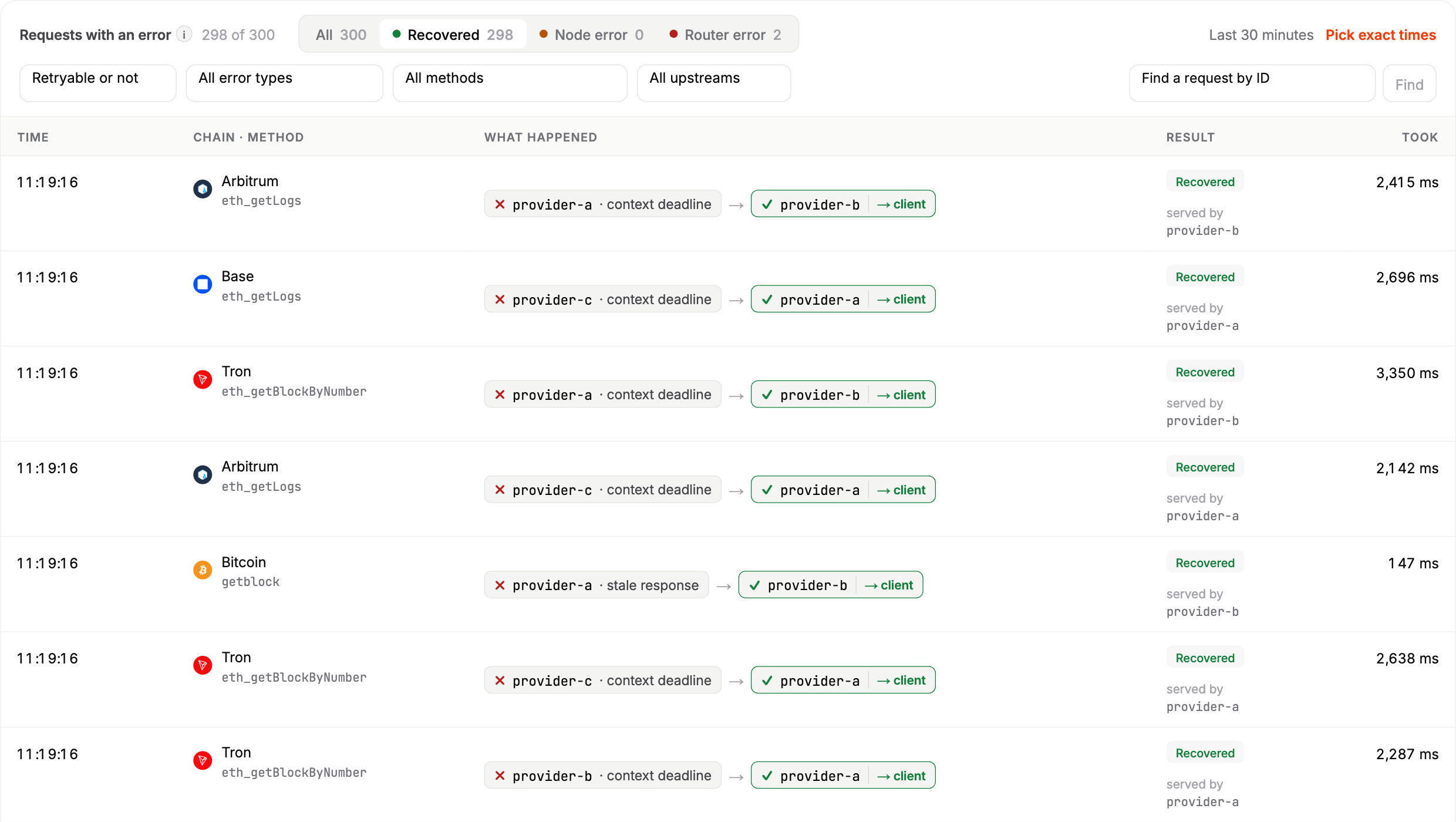
Every failed answer, and what the router did about it
How a provider is picked
Our routing algorithm scores every provider all the time, on speed, freshness and errors, and sends each request to the best one right now.
Providers that fall behind the chain or start failing are skipped, and a failed answer is tried again elsewhere.
Routing is tuned to what you need: speed, fresh data or cost.
# choose how providers are picked
--strategy balanced        # or: latency, sync-freshness, cost

# give one request its own time budget
curl -H "lava-relay-timeout: 5s" https://ethereum-mainnet-jsonrpc.<your-team>.magmadevs.com
Which providers serve each chain and in what order, how long to wait, how many retries, and how a provider is picked. Set it in your config, or we change it for you the same day.
What customers have said publicly about running Smart Router.
Fireblocks · Custody infrastructure
Fireblocks publicly documents its use of Smart Router.
Fireblocks describes Smart Router running beneath its applications in a published article.
“Magma Devs' Smart Router has been impactful in our ability to improve node reliability and performance, allowing our team to focus fully on core innovation.”
Treats on-chain data access as a reliable system component across 70+ blockchains.
Hypernative uses Smart Router for fault tolerance and deterministic failover, removing RPC behaviour as a variable in real-time threat detection.
“Smart Router allows us to treat onchain data access as a reliable system component rather than an external dependency, which is critical for real time threat detection.”