Client Profiling
Learn your normal blockchain activity patterns.
Reach 284 blockchain networks through our RPC providers, your own infrastructure, or both. One platform to secure, monitor, and intelligently manage every request. Detect anomalies, enforce security policies, ensure reliable connectivity, and gain complete visibility with AI-powered insights and audit-ready evidence.
Run in production by


284 networks behind one endpoint.
Learn moreEvery request goes to the provider most likely to answer it well right now.
Learn moreBlock-aware caching can reduce repeated upstream reads.
Learn moreUse our providers, yours, or both.
Learn moreChain data checked before you act on it.
Learn moreWe route around it in seconds, then tell you whose fault it was, with evidence.
Learn moreA record of each transaction you send: which providers received it and what each one answered.
Learn moreThe evidence your auditors ask for, from the system that served the traffic.
Learn moreLearn your normal blockchain activity patterns.
Detect unusual behavior and potential threats in real time.
Define security policies and receive actionable alerts.
Turn behavioral patterns and anomalies into actionable security insights.
BUYER QUESTIONS
Either. Use our providers, connect your own provider accounts and nodes, or mix them per chain. What is included depends on your plan.
Supported connectivity and interfacesThe router retries the request on another provider that can serve it, inside the same time limit. It needs a second provider set up for that chain to do this.
Provider selection and recoveryThe router tracks each provider's latest block, and a provider that falls behind stops being picked. You can also turn on a check that compares answers across providers for the reads you choose.
Data integrity controls and scopeWe run the routing, the provider connections, monitoring and operations. Your applications, keys, signing and business logic stay with you.
Managed connectivity responsibilitiesFIREBLOCKS
“With Magma Devs, we ensure our customers experience the speed, reliability, and data freshness they demand.”
From the Fireblocks article "Can you trust your blockchain data", written with the Magma team.
Read the article on Fireblocks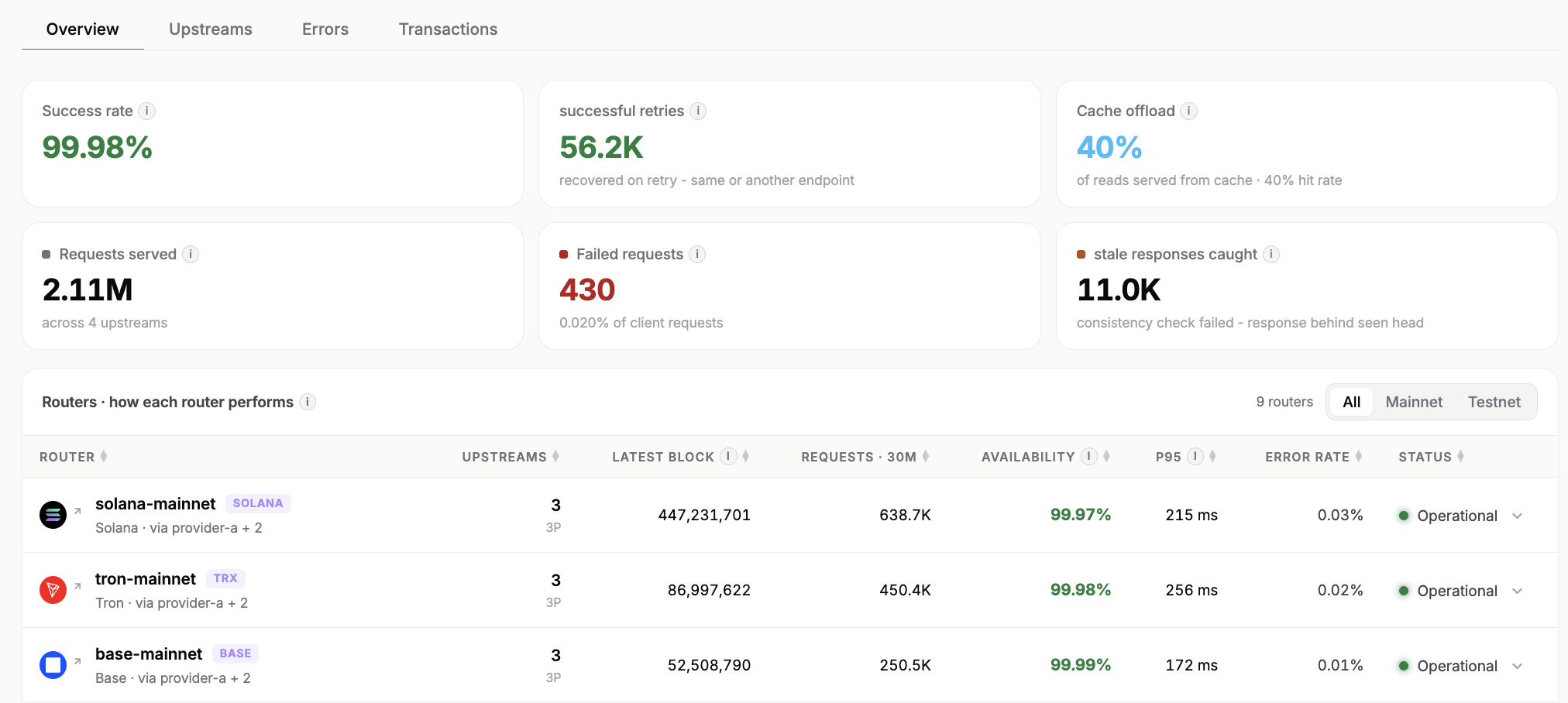

"As crypto markets mature, infrastructure matters as much as liquidity. Integrating Magma Devs' Smart Router strengthens the resilience and reliability of our platform at global scale. It allows us to deliver consistent performance and secure access to digital assets, even during periods of extreme market activity."

Most exchanges and custodians run RPC themselves: a few providers, some retry logic, their own dashboards. It works until a provider falls behind the chain and keeps answering, or rate-limits you in your busiest hour. Then the first hour goes on one question: is it us, the provider, or the chain?
Every reply carries headers that name the provider that served it and how many tries it took. Every failure is sorted by who caused it: your request, the contract, the provider, or the chain. A reverted contract never counts against a provider. When you want a person, our team looks at it with you, with the evidence.
On private hosting, your router runs in its own deployment. No other customer's traffic shares it.
The setup is sized to your agreement, so traffic keeps flowing if a server has a problem.
Your endpoints, settings and logs stay yours. You never lose access to your system.
Uptime commitments are set in your agreement.
| In-house proxy | Open-source proxy you run | RPC provider | Smart Router | |
|---|---|---|---|---|
| More than EVM chains | You build it | Partial | Their chains only | 284 Supported Blockchain Networks |
| Failover and retry across providers | You build it | Yes | Inside their network only | Yes |
| Rate-limit handling per provider | You build it | Yes | No | Yes |
| Cache shared across replicas | You build it | Yes | No | Yes |
| Run for you 24/7 | Your team | Your team | Yes | Yes |
| Compliance evidence (SOC 2 Type II, ISO 27001) | You build it | No | Varies | Yes |
Detailed comparisons:eRPC vs Smart RouterdRPC vs Smart RouterAlchemy vs Smart RouterQuickNode vs Smart RouterInfura vs Smart RouterAnkr vs Smart RouterTatum vs Smart Router
One platform for dependable blockchain connectivity.