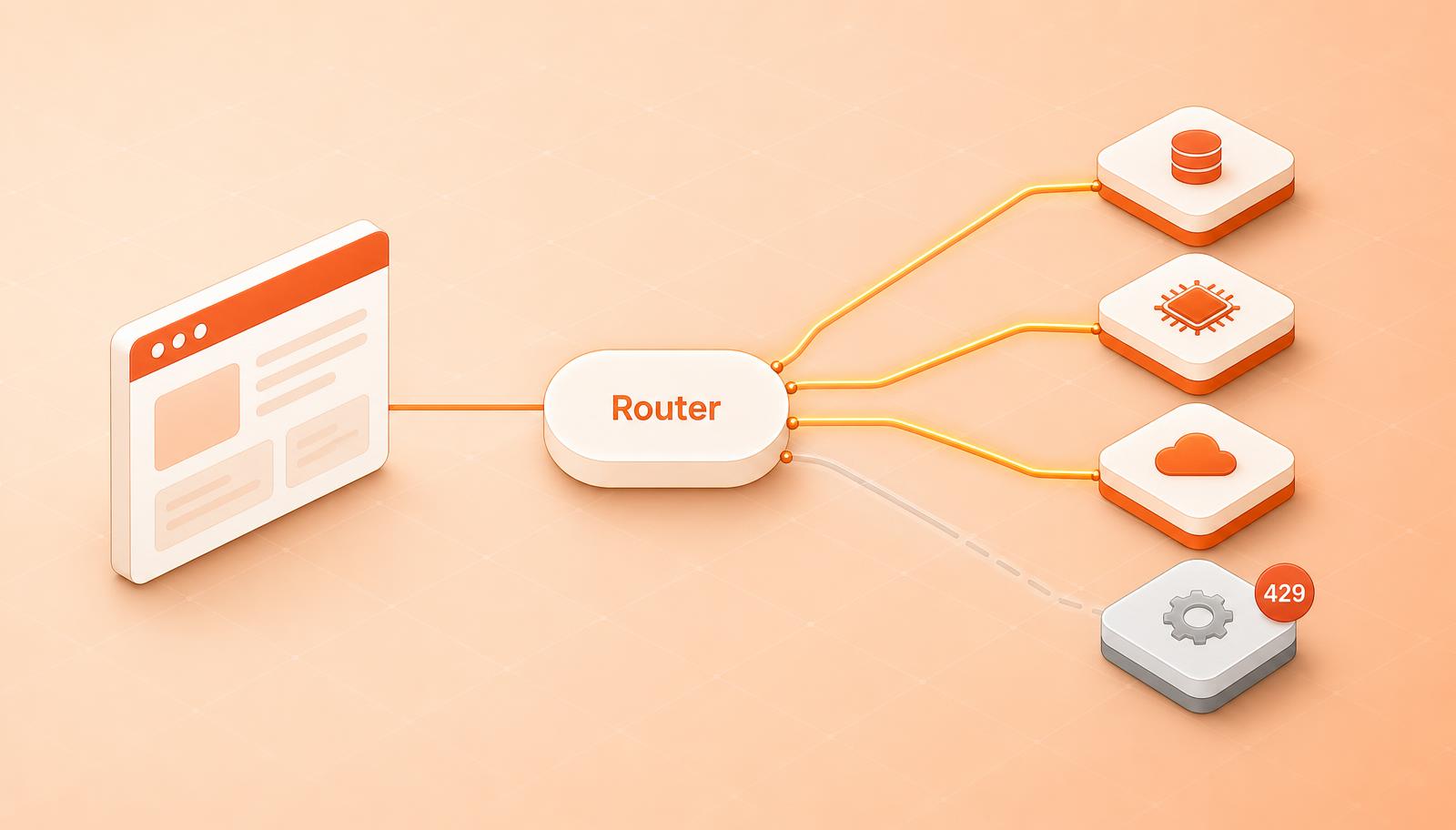
TL;DR
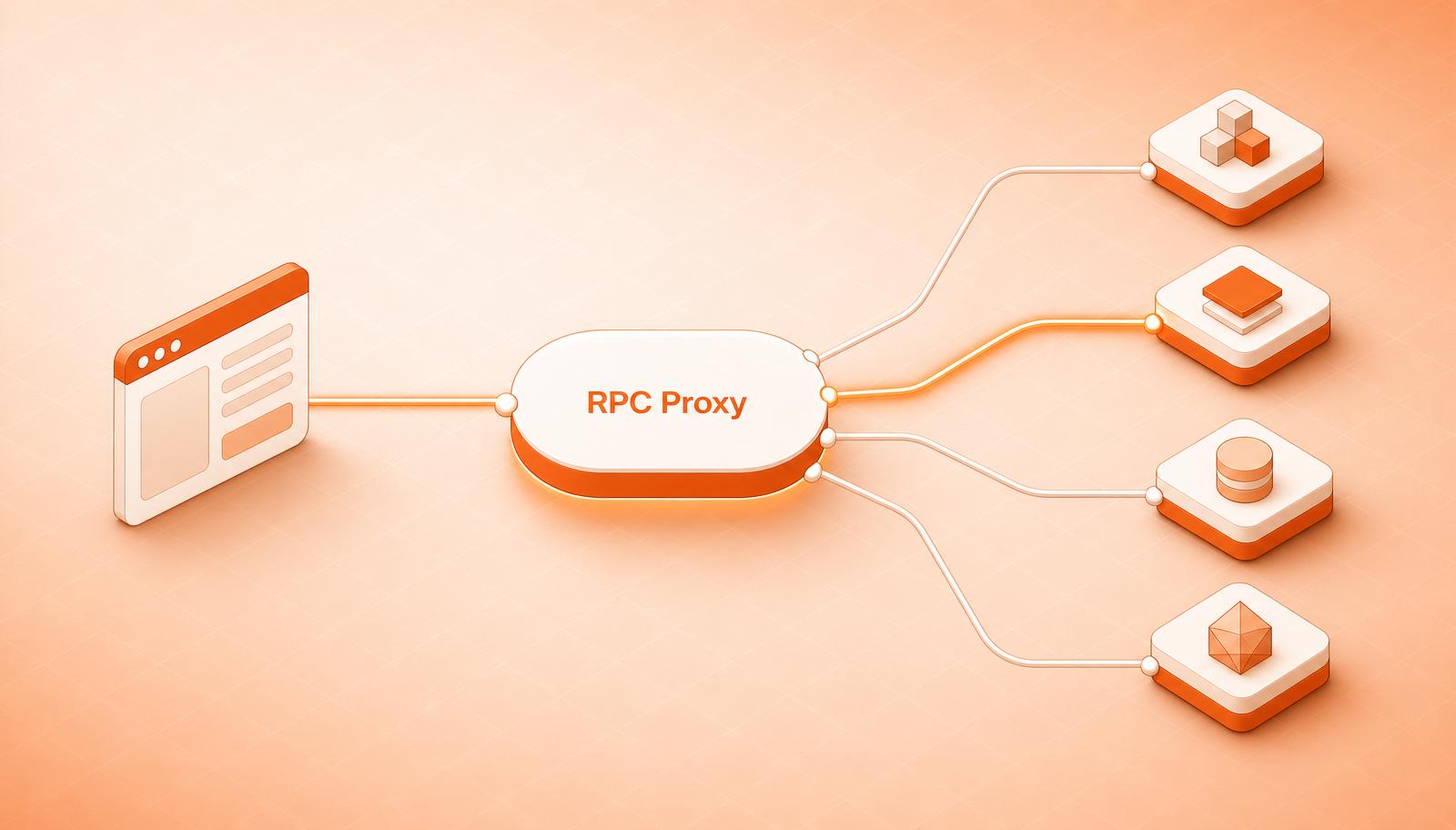
An RPC proxy is a service that sits between your application and your blockchain RPC endpoints. Your app sends every JSON-RPC request to one URL; the proxy decides which node or provider actually answers it, retries when a request fails, caches repeat reads, and can validate responses across sources before they reach your code. Any team that uses more than one provider, supports more than one chain, or handles reads and writes with financial weight ends up needing one. It replaces the failover logic scattered through your client code, the nginx config someone tuned once and nobody touches, and the shared doc of backup endpoint URLs your on-call engineer swaps in by hand.
What is an RPC proxy?
A proxy, in the ordinary networking sense, is an intermediary: a server that receives requests on behalf of other servers and forwards them. A blockchain RPC proxy applies that idea to RPC traffic. Instead of pointing your app directly at an RPC node or a provider endpoint, you point it at the proxy, and the proxy forwards each call to one of the upstreams behind it.
┌──────────┐  one URL  ┌───────────┐ ──▶  Alchemy
│ Your app │ ────────▶ │ RPC proxy │ ──▶  Infura
└──────────┘           └───────────┘ ──▶  Self-hosted node
                                     ──▶  QuickNode
The upstreams can be commercial providers (Alchemy, Infura, QuickNode, Helius), public endpoints, your own self-hosted nodes, or any mix. From your application's point of view nothing changes: it still speaks ordinary JSON-RPC to a single endpoint. That is why the term JSON-RPC proxy is often used interchangeably; the proxy speaks the same protocol as the nodes behind it, so adopting one requires no client migration.
The interesting part is everything the proxy does between receiving a request and returning a response. A dumb proxy just forwards. A useful one makes decisions.
What an RPC proxy actually does
The value of an RPC proxy is the set of policies it applies to every call. In practice, seven capabilities cover most of what teams deploy one for.
Failover. When an upstream is unreachable, errors, times out, or serves data behind the chain head, the proxy resends the request to another upstream instead of surfacing the error to your app. Client libraries can approximate this, but a proxy applies it uniformly across every service you run, in one place.
Load balancing. The proxy distributes traffic across the upstream pool. For blockchain traffic, doing this well means scoring nodes on latency, sync freshness, and error rate rather than rotating blindly; round-robin is not enough when a node can be lagging and still answering.
Method-aware routing. Not every upstream serves every request equally. Archive queries need archive nodes, eth_getLogs behaves differently across providers, and heavy calls deserve different treatment from light ones. A chain-aware proxy parses the request, categorizes it, and narrows the pool to upstreams that can actually serve it.
Caching. Many RPC workloads are highly repetitive. A proxy can serve repeat reads from a cache instead of paying an upstream for each, cutting cost and latency. Done properly the cache is block-aware: finalized data is cached long-term, "latest" reads get very short lifetimes, and writes are never cached.
Cross-provider validation. Because the proxy sees multiple upstreams, it can send a sensitive read to several in parallel and only return a response once a quorum agrees. This catches a buggy, stale, or malicious node before its answer reaches your users, which no single-provider setup can do.
Observability. All your RPC traffic flows through one point, so one point can measure it: per-provider latency, error rates, lag behind the head, retry and failover counts, cache hit rates. Without a proxy, this picture is scattered across every service and provider dashboard you use.
Auth and rate limits. The proxy is also a natural enforcement point: API keys for your internal consumers, per-consumer rate limits, and a single place to rotate provider credentials without redeploying applications.
Precise definitions for these mechanisms (retry vs. hedging, integrity checks vs. cross-validation, quorum) live in the RPC reliability glossary.
RPC proxy vs. RPC node vs. RPC gateway vs. load balancer
These four terms get blurred constantly, and the confusion is understandable because one URL can hide any of them. They sit at different layers.
| RPC node | Load balancer | RPC proxy | RPC gateway | |
|---|---|---|---|---|
| What it is | A machine running blockchain client software | Generic traffic distributor (nginx, HAProxy, cloud LB) | Chain-aware intermediary in front of RPC endpoints | Usually a provider's managed entry point to their fleet |
| Understands JSON-RPC? | Yes, it answers it | No, it sees connections and HTTP | Yes, it parses methods and responses | Yes |
| Typical owner | You or a provider | You | You (self-hosted) or a vendor | The provider |
| Failover across providers | No | Only crude liveness checks | Yes, policy-based | Within that provider only |
| Validates response correctness | No | No | Can, via cross-validation | Generally no |
| Example | Geth, a Solana validator with RPC enabled | nginx upstream block | Smart Router, eRPC | A provider's "one endpoint, many chains" URL |
Two distinctions do most of the work. A proxy differs from a load balancer by protocol awareness: a layer-7 balancer distributes traffic but cannot tell a synced node from one 40 blocks behind, because both return HTTP 200. And RPC gateway vs. proxy is mostly a question of ownership: "gateway" usually names a provider's managed front door to their own infrastructure, while a proxy is a layer you control in front of many providers, including that gateway. The RPC vs. node vs. API article untangles the underlying vocabulary in more depth.
When you need an RPC proxy
Not every project needs this layer on day one. A prototype on a single free endpoint does not. The trigger points are concrete:
You use, or should use, more than one provider. The moment a second provider exists, something has to decide which one gets each request and what happens when one degrades. That something is a proxy, whether you buy it or grow it accidentally inside your codebase. The alternative, staying on one provider, is its own well-documented risk.
Your workload is regulated or institutional. Custodians, exchanges, and wallet infrastructure need to demonstrate that chain data is available and correct, not just assume it. A proxy gives you the audit trail (who answered, how fast, did sources agree) and the controls to back that up.
Your writes carry real value. A transaction broadcast that fails or hangs during volatility is a direct financial loss. A proxy can broadcast writes to several upstreams in parallel and let the fastest confirmation win, which is meaningfully more reliable than one provider's ingest path at peak load.
You are multichain. Every chain multiplies endpoints, providers, method dialects, and failure modes. A proxy collapses that back to one integration point per app, with per-chain policy underneath.
Solana is the stress test
If one ecosystem makes the case for RPC proxies on its own, it is Solana. Solana RPC routing is harder than the EVM equivalent in specific ways: the chain speaks its own JSON-RPC dialect rather than Ethereum's, node health has to be judged by slot rather than block height (slot and block height diverge with the skip rate), and traffic spikes are more violent because activity concentrates around launches and liquidation cascades. Provider performance during those spikes diverges wildly, which is exactly the condition a health-scoring proxy exploits: it routes toward whichever upstream is coping and away from whichever is buckling, minute by minute.
The January 2025 $TRUMP launch made this concrete. Solana DEX volume hit $25 billion in under 48 hours, providers across the ecosystem congested one after another, and Fireblocks, routing its 1,000% Solana traffic spike through a proxy layer rather than at providers directly, held 100% uptime with transaction broadcast times of 47 milliseconds. A Solana RPC proxy is the same architecture as on any other chain; Solana just punishes its absence faster.
Build vs. buy
Basic proxying is a weekend project: accept a request, try upstream A, on error try upstream B. Production-grade proxying is not. Health scoring, per-chain lag thresholds, error classification, hedged requests, safe caching, quorum comparison, and the observability to debug all of it add up to a system teams maintain for years. RPC proxies have been built in-house thousands of times, and most of those builds stall at the basic tier. The full trade-off, including when building is the right call, is covered in build vs. buy for the RPC routing layer.
Open source vs. managed RPC proxies
If you decide not to build, the landscape splits into proxies you run and proxies you route through.
eRPC is an open-source, EVM-first RPC proxy you self-host and tune: retries, hedging, failover, and caching as a DIY toolkit. Comparison: eRPC vs. Smart Router.
dRPC takes the opposite shape: a managed, decentralized network you send traffic into, with load balancing across its own node operators rather than a layer you run in front of your providers. Comparison: dRPC vs. Smart Router.
Tatum offers a managed orchestration layer with geo and load-based routing across 100+ chains. Comparison: Tatum vs. Smart Router.
Smart Router by Magma Devs is an open-source proxy (with managed Cloud and Enterprise tiers) that sits in front of the providers and nodes you already use, adding routing, failover, validation, and observability without a migration.
The axis that matters most for institutional workloads is data validation: most options balance load and retry errors, while few can require multiple independent sources to agree before a response is returned.
How Smart Router implements it
Smart Router is the RPC proxy pattern built out as a maintained, chain-agnostic component. In terms of the capabilities above:
- QoS-scored routing instead of rotation. Every request is categorized, then routed by per-upstream scores on latency, sync freshness, and availability, with configurable strategies per workload.
- A full failover pipeline. Retry to a different node on retryable errors, hedged parallel attempts against slow nodes, pre-request integrity checks that skip lagging upstreams, and a circuit breaker when the pool is exhausted.
- Opt-in cross-validation. Sensitive reads fan out to a quorum of upstreams, with group-diversity rules so three copies of the same infrastructure cannot outvote the truth.
- Block-aware caching and parallel broadcast. Finality-keyed caching cuts upstream volume, and write methods can broadcast to all eligible upstreams at once so the fastest confirmation wins.
- Chain-agnostic by spec. Chain specs cover 100+ networks across EVM, Solana, Cosmos, and more, over JSON-RPC, REST, gRPC, Tendermint, and WebSocket, so one proxy serves your whole chain matrix.
It deploys as a Docker image, a Helm chart, or a static binary next to your validators; three commands get a proxy running in front of your existing endpoints.
Frequently asked questions
Is an RPC proxy the same as an RPC node? No. A node runs blockchain client software and holds chain state; it is the thing that answers questions. A proxy holds no chain state of its own. It receives your requests and decides which node answers them, adding routing, retries, caching, and validation along the way.
Do I need an RPC proxy if I only use one provider? The routing benefits are thin with a single upstream, but caching, observability, and rate limiting still apply, and the proxy makes adding a second provider a config change instead of a code change. That said, if your traffic matters enough to justify a proxy, it usually matters enough to justify a second provider too.
Does an RPC proxy add latency? It adds one network hop, typically single-digit milliseconds when deployed near your app. In practice the net effect is usually faster: cache hits skip the upstream entirely, health-based routing avoids slow nodes, and hedging cuts tail latency. Fireblocks measured transaction broadcast going from roughly 1.5 seconds to 47 milliseconds behind a proxy layer during peak Solana congestion.
Can an RPC proxy work with private or self-hosted nodes? Yes. A proxy's upstream pool is just a list of endpoints, so self-hosted nodes, private validator RPCs, and commercial providers can sit side by side, with the same scoring, failover, and validation applied to all of them. Many teams run exactly this mix: their own nodes for control, providers for burst capacity.
Is Smart Router a free RPC proxy? The core is open source under the PolyForm Noncommercial license: free to evaluate, develop against, and use non-commercially, with the code on GitHub. Production and commercial use are covered by the paid tiers, which add a production license, managed deployment options, and SLAs.
Smart Router is open source. You can deploy it in front of your existing providers this afternoon, or talk to us about the enterprise edition.
Sources: Smart Router documentation; Why Smart Router; Supported chains; Fireblocks during the $TRUMP launch.
How exposed is your RPC stack?
Take the 2-minute Secure RPC Assessment and get a personalized risk report.
Run the assessment