If you are building anything on a blockchain (a wallet, an exchange, a custody platform, an on-chain monitoring tool), you have almost certainly used an RPC node without stopping to think about what it is. It is the piece of infrastructure your app talks to every second, and the piece most teams understand the least until it breaks.
This guide starts as plainly as possible, then adds the depth that engineers actually need. By the end you will know what an RPC node is, how your app uses it to read and write blockchain data, the trade-off between running your own node and using a provider, and why serious teams eventually stop relying on a single node and move to routing across several.
What is an RPC node? The short version
An RPC node is a computer that runs blockchain software and answers questions about the chain over the internet.
"RPC" stands for Remote Procedure Call, a decades-old idea in computing where one program asks another program, running somewhere else, to do something on its behalf. In the blockchain world, the "something else" is a node that keeps a copy of the blockchain, and the "call" is your app asking it a question like what is the balance of this wallet? or telling it please broadcast this transaction.
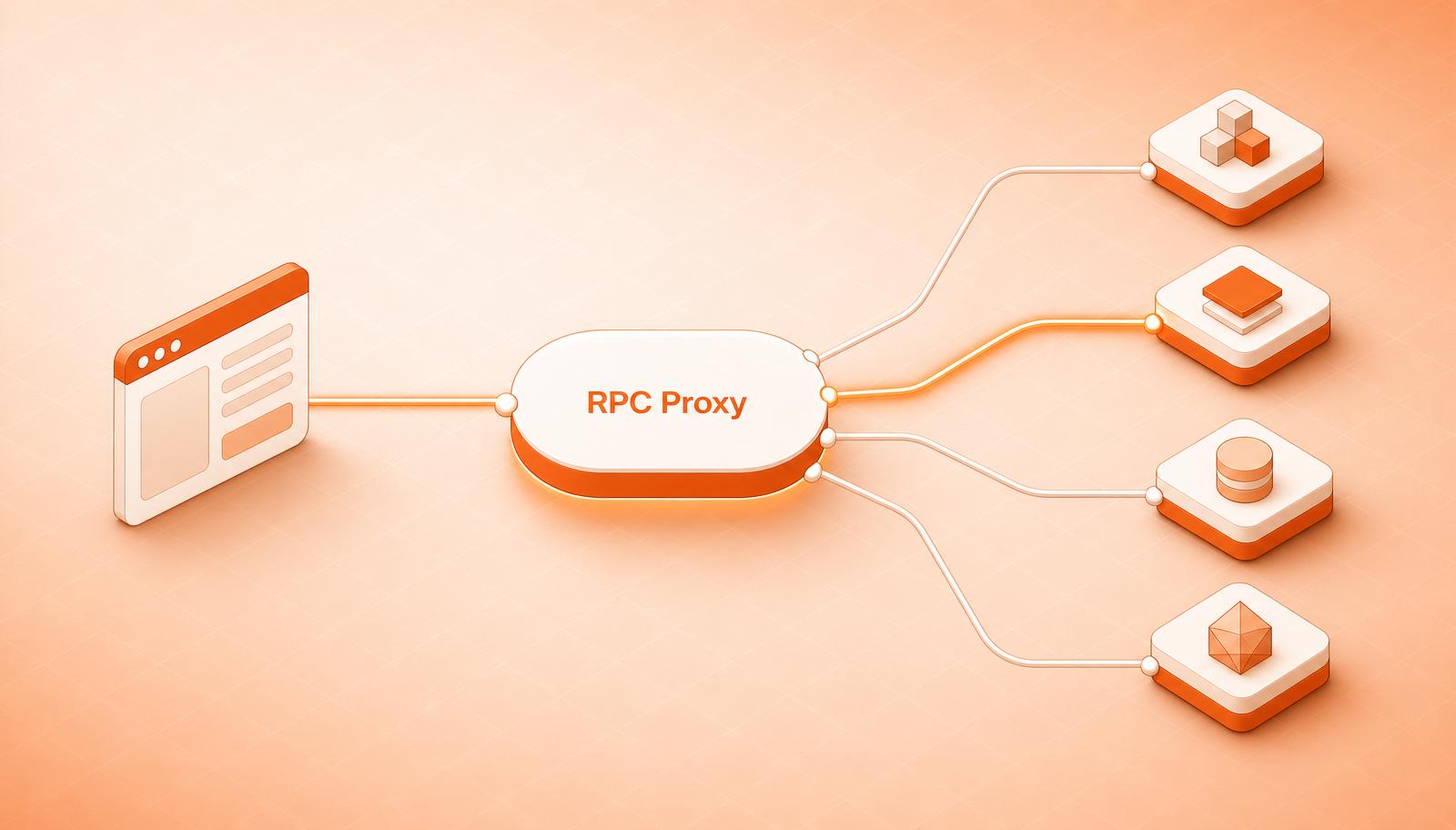
So the RPC node meaning, in one sentence: it is your application's doorway to the blockchain. Your app does not talk to "the network" directly. It talks to a node, and that node talks to the network on your behalf.
A quick analogy. A blockchain is a shared ledger copied across thousands of computers. You cannot phone the whole network and ask a question. Instead you ask one of those computers, a node, that already has the full ledger and knows how to look things up and pass messages along. A blockchain RPC node is simply a node that has opened a service endpoint so outside applications can send it those questions and commands.
What an RPC node actually does
Everything your app needs from a blockchain falls into two buckets: reading data and writing data. An RPC node handles both.
Reading is asking the chain for information that already exists:
- What is the balance of this address?
- Has this transaction been confirmed yet?
- What is the latest block number?
- What does the current state of this smart contract look like?
Writing is submitting something new to the network:
- Broadcast this signed transaction so validators can include it in a block.
When your app makes a read request, the node looks up the answer in its own copy of the chain and replies. When your app submits a transaction, the node relays it into the network's mempool, where validators pick it up and eventually include it in a block. According to ethereum.org, running a node is what lets you verify data against the network's rules for yourself rather than trusting a third party to be honest and accurate. That is exactly why the node sits at the center of every serious blockchain application.
The important mental model: your app is only ever as correct and as available as the node answering its requests. If the node is down, your app cannot read balances or send transactions. If the node returns stale or wrong data, your app makes decisions on bad information. Hold onto that idea; it drives everything later in this article.
How apps talk to a node: JSON-RPC in brief
When your app "asks the node a question," it does so in a specific, standardized format. On most chains that format is JSON-RPC, a lightweight convention for sending a request as a small chunk of JSON and getting a JSON response back.
A read request to an Ethereum node looks like this:
{ "jsonrpc": "2.0", "method": "eth_blockNumber", "params": [], "id": 1 }
You are naming a method (eth_blockNumber), passing any parameters it needs, and tagging it with an id so you can match the response to the request. The node replies with a JSON object containing the answer. Libraries like viem, ethers.js, web3.py, and cosmjs wrap all of this so you rarely hand-write the JSON, but underneath, that is what is crossing the wire.
Different ecosystems expose different method sets. Ethereum-style chains use methods like eth_getBalance and eth_sendRawTransaction, Solana and Cosmos have their own, and some also offer REST, gRPC, or WebSocket interfaces. JSON-RPC is the common thread across most of them.
Running your own node vs. using a provider
Once you know you need a node, the next question is: do you run one yourself, or do you pay someone to run it for you? This is one of the first real infrastructure decisions a blockchain team makes.
Running your own node
You can download the client software, sync a full copy of the chain, and operate the node on your own hardware or in your own cloud. This gives you maximum control and privacy: you are not sending your users' queries to a third party, and you verify everything against the network's rules yourself.
The cost is operational. Nodes need capable hardware and a lot of disk, especially for archive nodes that retain full historical state. They take time to sync, they need monitoring, and they need patching and upgrades whenever the chain forks or the client releases a new version. Multiply that across every chain you support and it becomes a standing engineering commitment. As Magma has noted, node work is where a large share of infrastructure maintenance time actually goes.
Using an RPC provider
An RPC provider (Alchemy, Infura, QuickNode, Chainstack, Ankr, Helius, and many others) runs the nodes for you and hands you an endpoint URL. You point your app at it and start making requests. No syncing, no hardware, no client upgrades. For most teams this is how they start, because it turns a hard operational problem into a single line of configuration.
The trade-off is dependency. You are now relying on that provider's uptime, performance, rate limits, and honesty. Their outage is your outage. Their throttling during a market spike is your throttling. And you are trusting that the data they return is accurate.
There is no permanent "right" answer
Most teams use providers, some run their own nodes, and many mature teams do both: self-hosted nodes for control plus commercial providers for burst capacity and redundancy. What matters is recognizing that whichever path you pick, if everything routes through a single node or a single provider, you have concentrated a lot of risk in one place. That is the thread we pick up next.
What goes wrong with a single RPC node
A single node or single provider is simple to set up and often works fine early on. But as your product becomes important, the same setup becomes fragile. Here is what actually goes wrong.
Downtime. Providers and nodes go down, sometimes without warning. When your only node is unreachable, your app can no longer read data or submit transactions. Users see stuck transactions, missing balances, failed withdrawals, and broken flows.
Rate limits. Providers throttle requests once you cross a usage threshold, and that threshold tends to bite at the worst possible moment: during a token launch, a liquidation cascade, or a volatility spike, exactly when reliability matters most.
Stale or bad data. The most dangerous failure is not silence. It is a confident wrong answer. A node that has fallen behind the chain head, or is buggy, or has been tampered with, can return stale or inaccurate data. If your app trusts a single source blindly, it has no way to know the answer is wrong. This is not hypothetical: Magma has documented a case, the $292M KelpDAO / LayerZero exploit, where poisoned RPC data, not a smart-contract bug, was the attack vector.
Single point of failure. Downtime, latency, rate limits, and bad data all share one root cause: everything depends on one path. One provider, one endpoint, one routing decision. When that path degrades, there is no alternative to fall back to. Magma's write-up on the hidden risk of relying on a single RPC provider frames the real question well: if your primary node returns bad data or goes dark tomorrow, how quickly would you even know, and how quickly could you recover?
If the answer is "our on-call engineer would manually swap endpoints," you do not have resilience. You have an incident-response plan. For critical infrastructure, that is not enough.
Why teams move to routing and redundancy across multiple nodes
The fix for a single point of failure is not a better single node. It is more than one node, with something intelligent sitting in front of them.
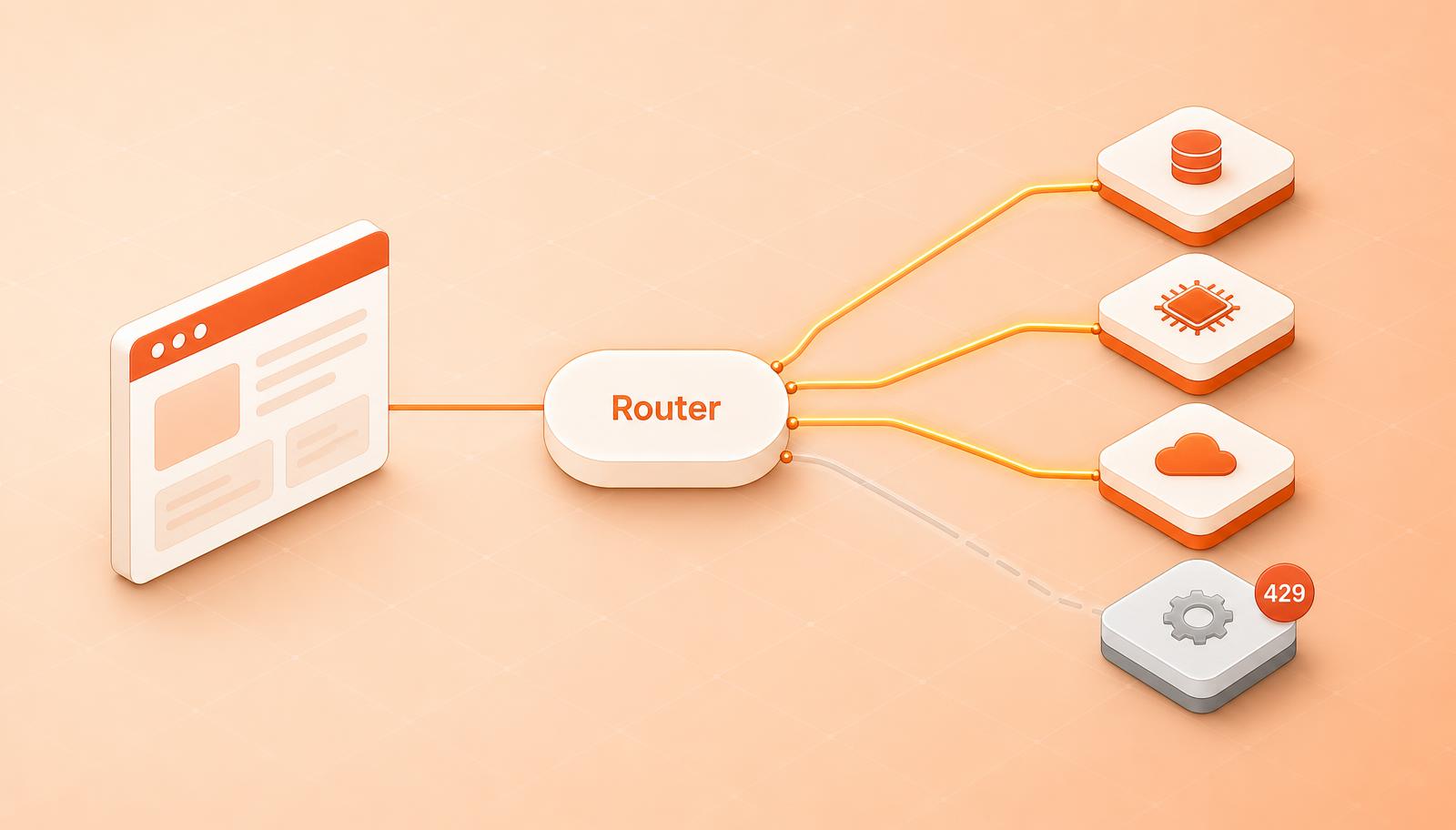
A resilient RPC setup usually includes several nodes or providers, automatic failover when one fails, performance-based routing so requests go to healthy sources, continuous health checks, and some way to validate that responses are actually correct. In plain terms: your app should not ask one node and hope. It should be able to compare, route around problems, and detect bad answers before they reach users.
The catch is that building this yourself is real engineering. Basic failover ("if node A errors, try node B") is easy. But production-grade routing means health-scoring every provider in real time, handling partial failures, avoiding routing storms, caching safely without serving stale data, validating responses across sources, and instrumenting all of it so you can see what happened. Teams have rebuilt this same layer in-house thousands of times.
Where Smart Router fits
Smart Router by Magma Devs is that routing-and-redundancy layer built as a standard, open-source component instead of something every team reinvents. It sits between your application and the chain and routes traffic across the RPC nodes and providers you already use: public endpoints, dedicated providers, or your own self-hosted nodes. Because it speaks the same JSON-RPC (and REST, gRPC, WebSocket) interfaces your app already uses, adopting it does not mean migrating off your current providers.
A few things it does that map directly to the failure modes above:
- Intelligent node selection. Rather than picking a node at random, Smart Router scores providers on latency, how close they are to the chain head, and recent reliability, then routes accordingly. You can bias this toward low latency, freshness, cost, or accuracy depending on the workload.
- Automatic failover. If a node is unavailable, errors, returns stale data, or times out, the request fails over to another eligible node instead of surfacing an error to your app.
- Cross-validation. For sensitive reads, the same request can be sent to several nodes in parallel and only returned once a quorum agrees, which catches a single node returning a wrong or malicious answer before that data reaches your client. It is opt-in per request because it multiplies upstream cost.
- Block-aware caching and observability. A cache serves repeat reads without hammering upstreams while avoiding stale data, and built-in metrics, traces, and a dashboard give you visibility into what every node is doing.
To be clear about scope: Smart Router does not make individual nodes faster or remove the need for good providers, and it is not a silver bullet that eliminates every risk. What it does is take the multi-node routing, failover, and validation logic that resilient setups require and provide it as a maintained layer, so your team does not have to build and operate that logic itself. Magma reports meaningful results from this approach in production (on the order of far fewer surfaced RPC errors and a large reduction in upstream calls through shared caching), and it runs today in front of teams like Kraken, Fireblocks, and Galaxy. As always, the right measure is how it performs against your own workload.
Putting it together
An RPC node is your application's doorway to the blockchain: it reads chain data, submits your transactions, and speaks JSON-RPC to do it. You can run one yourself for control or use a provider for convenience, and both are reasonable. What is not reasonable, for anything critical, is routing everything through a single node and hoping it never fails, falls behind, or lies.
The mature setup is multiple nodes with intelligent routing, automatic failover, and response validation in front of them, so a single bad or unavailable node becomes a non-event instead of an outage. If you want to go deeper on exactly why one provider is a liability and what a stronger setup looks like, read The Hidden Risk of Relying on a Single RPC Provider.
Sources: ethereum.org, Nodes and clients; Smart Router documentation; Magma Devs blog.
How exposed is your RPC stack?
Take the 2-minute Secure RPC Assessment and get a personalized risk report.
Run the assessment