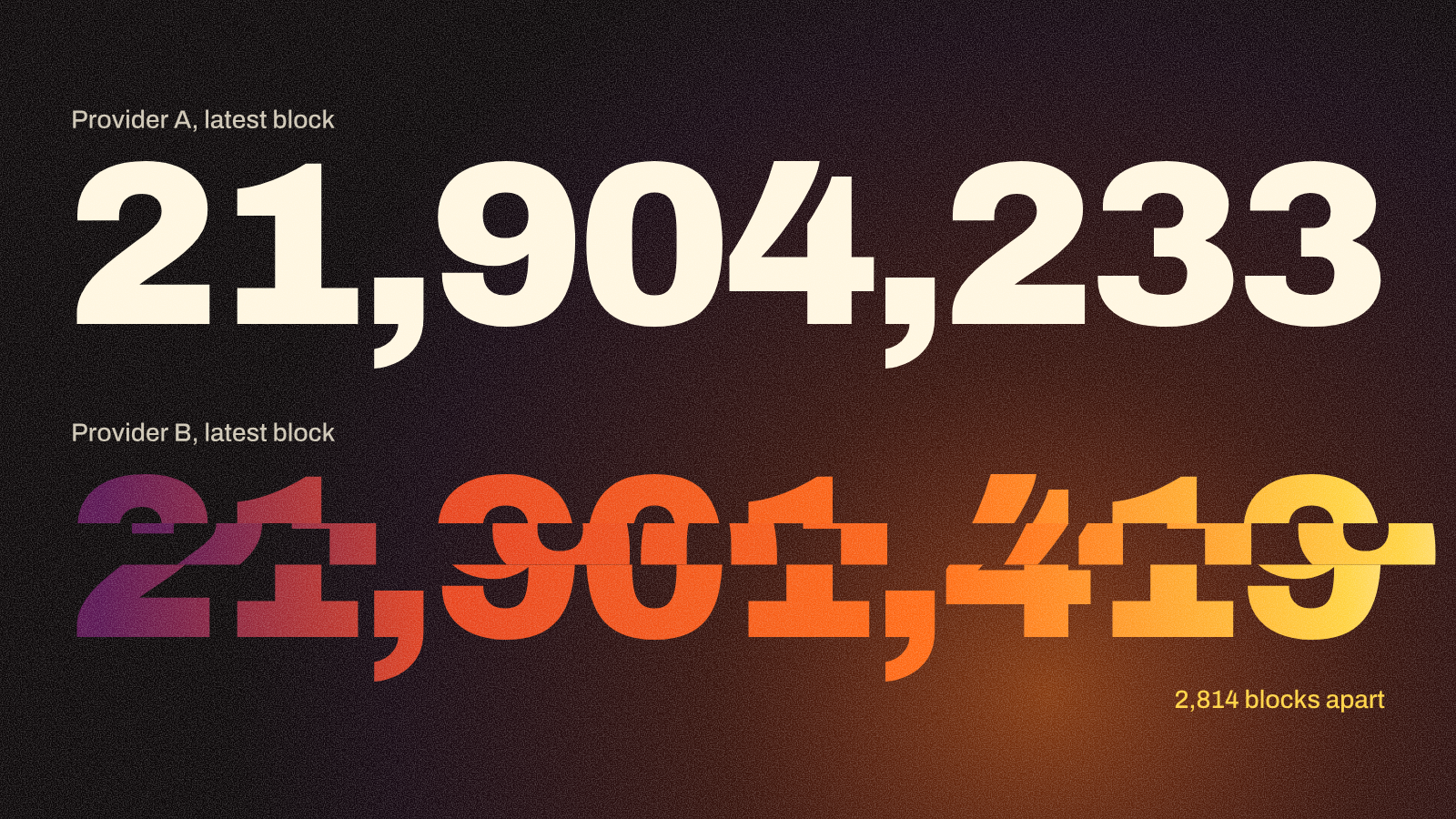
Ask two RPC providers for the latest block and you will often get two different answers. Most of the time they are a block or two apart and nobody cares. Sometimes they are minutes apart. Then your product has to pick one, and whichever it picks decides whether a customer's deposit shows up on time.
Why providers disagree
A provider is not one node. It is many nodes behind one URL, and your request lands on whichever one the provider chooses. Nodes fall behind during upgrades, under load, or when they lose their peers. On a chain that produces a block every 400 milliseconds, a node that is ten seconds behind is already 25 blocks short.
So a provider can answer quickly, with a clean HTTP 200, from a node that has not seen the last few minutes of the chain. Nothing in the reply says so.
What it costs
- A deposit is credited late, or a balance is wrong for a while.
- A lookup for a transaction that exists comes back "not found".
- Your reconciliation job sees a gap that is not real and wakes someone up.
None of these is an outage. Every one of them is a support ticket.
What we see across our fleet
Data from Magma's managed fleet.
We looked at up to 30 days of data from the chains we route for managed customers, sampled every 10 minutes.
- On 32 of the 44 routes that had two or more providers, one provider was at least five minutes behind another at some point.
- On a typical route this lasted about 0.2% of the time, roughly an hour and a half a month.
- One provider's reported latest block went backwards more than 2,400 times on a single chain. The largest jump was about 2,800 blocks.
- 22 of 40 mainnet routes had two providers or fewer.
Slow chains with irregular block times, such as Bitcoin, look worse in this kind of measurement than they are, so read the first two numbers as a rough guide.
Three ways to decide
Follow the highest block. This is simple, and it is usually right, because the common failure is one stale provider. It goes wrong when a provider reports a block that is not real, or when its answer jumps back and forth.
Hold at the last block they agree on. This protects you from a provider that is wrong. The cost shows up when you have only two providers and both are unstable: there is nothing to break the tie. We have seen a network with two providers where both swung by hundreds to thousands of blocks, and holding the agreed block kept the gateway behind the chain for about an hour.
Take the majority of three or more. A third provider breaks the tie. It costs more, and it is the only one of the three that handles both failure types.
What we would do
- Use three providers on chains where a stale read costs money. Two providers covers you when one goes down. It does not cover you when they disagree.
- Treat a backwards jump as a fault in the provider. A move of one or two blocks can be a real reorganization, where the chain replaces its most recent blocks. A move of hundreds is almost always the provider switching you to a node that is behind.
- Alert on the gap itself. Measure how far the block you are serving is behind your fastest provider, and page someone when it stays wide.
- Tell the caller. Return the block height with the answer, so the product can decide whether it is fresh enough for what it is about to do.
- Decide per chain. A five-block gap means two seconds on one chain and an hour on another.
Four questions for your own setup
- How many providers do you have on each chain, and which chains have fewer than three?
- When two of them disagree, which one wins, and did anyone choose that on purpose?
- Would you know within five minutes if you were serving old blocks?
- After the fact, can you tell which provider gave you the stale answer?
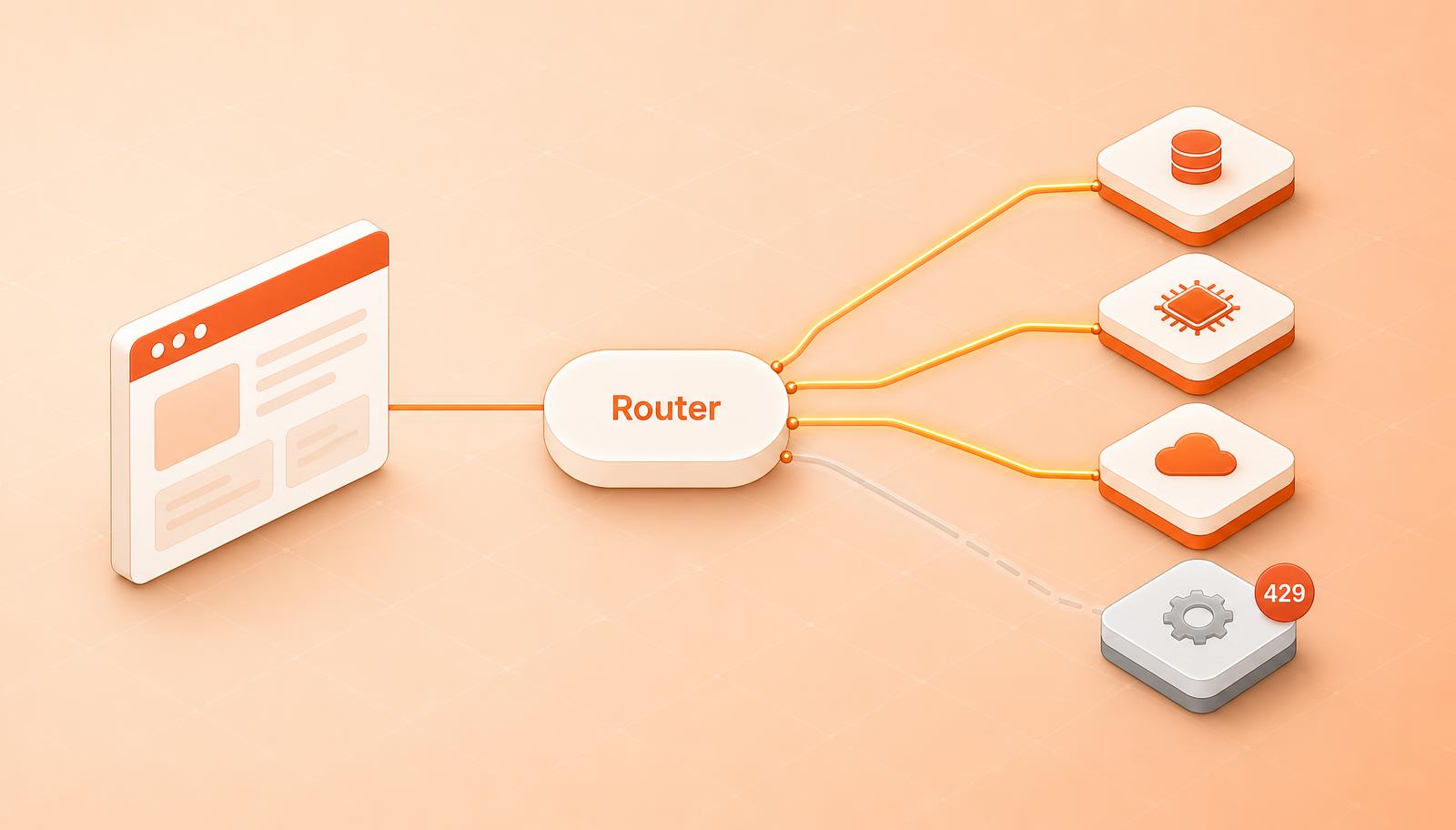
If you cannot answer these, you have found the work. Sitting between your product and its providers and answering them is what a blockchain gateway is for.
How exposed is your RPC stack?
Take the 2-minute Secure RPC Assessment and get a personalized risk report.
Run the assessment