A lagging node answers with HTTP 200, valid JSON, and thirty-second-old state. Round-robin keeps sending it traffic. Here's what chain-aware selection does instead.
RPC load balancing is the practice of distributing your application's blockchain RPC requests across multiple nodes or providers instead of sending everything to one endpoint. Done well, it removes the single point of failure that a lone provider represents and routes each request to the node most likely to answer it fast and correctly. Done naively, it spreads your traffic evenly across nodes that are slow, erroring, or seconds behind the chain head, and your users inherit whichever node's problem the rotation lands on.
Most teams reach for the naive version first: put the endpoints behind nginx or HAProxy, set the balancing algorithm to round-robin, and move on. That works for stateless web servers. It fails for blockchain RPC, and this article explains why, then walks through what health-aware RPC node selection actually looks like in practice.
What RPC load balancing has to solve
A pool of RPC nodes is not a pool of interchangeable web servers. At any given moment, the nodes behind your endpoints differ in ways that directly change the answers your application gets:
They fall behind the chain head. A node that lost peers or is struggling to keep up will still answer requests. It will answer them with old state: a balance from thirty seconds ago, a transaction that "doesn't exist" because the node hasn't seen its block yet. The response is well-formed, fast, and wrong.
Their latency diverges. Two providers on the same chain can differ by hundreds of milliseconds depending on region, load, and how they run their infrastructure. Latency also shifts over time; the fastest provider this hour may be the slowest during the next volatility spike.
They return errors at different rates. Rate limits, timeouts, and internal errors are unevenly distributed across providers and change with load. During the traffic bursts that matter most, error rates spike on exactly the providers everyone else is also hammering.
They can serve bad data. Beyond staleness, a buggy or compromised node can return responses that are simply incorrect. An application that trusts whichever node the balancer picked has no way to notice.
So the real job of a load balancer for RPC traffic is to answer one question per request: of the nodes available right now, which one is synced, healthy, and fast for this kind of call? Round-robin never asks that question.
Why round-robin isn't enough
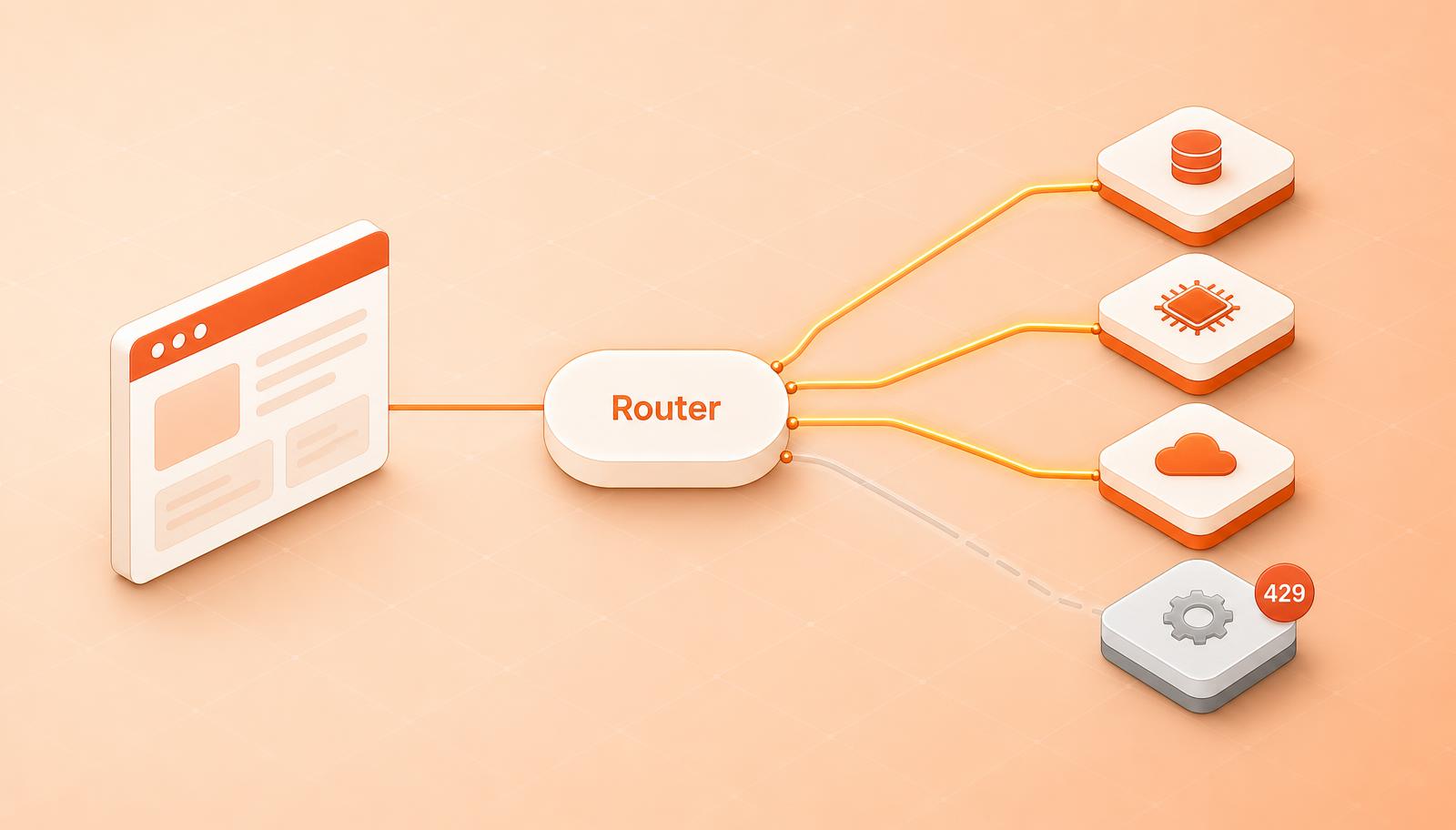
Round-robin has one rule: next request goes to the next node in the list. It is blind by design. It doesn't know that node C is 40 blocks behind, that node A's p95 latency tripled five minutes ago, or that node B has been returning 429s for the last thirty seconds. Each of those nodes keeps receiving exactly its share of your traffic.
The failure math is unforgiving. With three nodes in rotation and one of them lagging behind the chain head, a third of your reads return stale state, and they do so silently, with HTTP 200 and valid JSON. A health check that pings /health or even calls eth_blockNumber on the node itself won't catch it, because a lagging node happily reports its own (old) latest block. You need to compare the node against the chain head its peers have reached, which requires the balancer to understand the chain, and a plain layer-7 balancer doesn't.
Weighted round-robin and least-connections variants don't fix this either. They redistribute volume; they still don't see sync status, per-method behavior, or data correctness. Load balancing web servers is about spreading load. Load balancing RPC endpoints is about avoiding the wrong node, and that requires health, freshness, and correctness signals that generic balancers don't collect. (The distinction between an endpoint, a node, and a provider matters here; the RPC glossary defines each precisely.)
Smarter selection: scoring nodes instead of rotating them
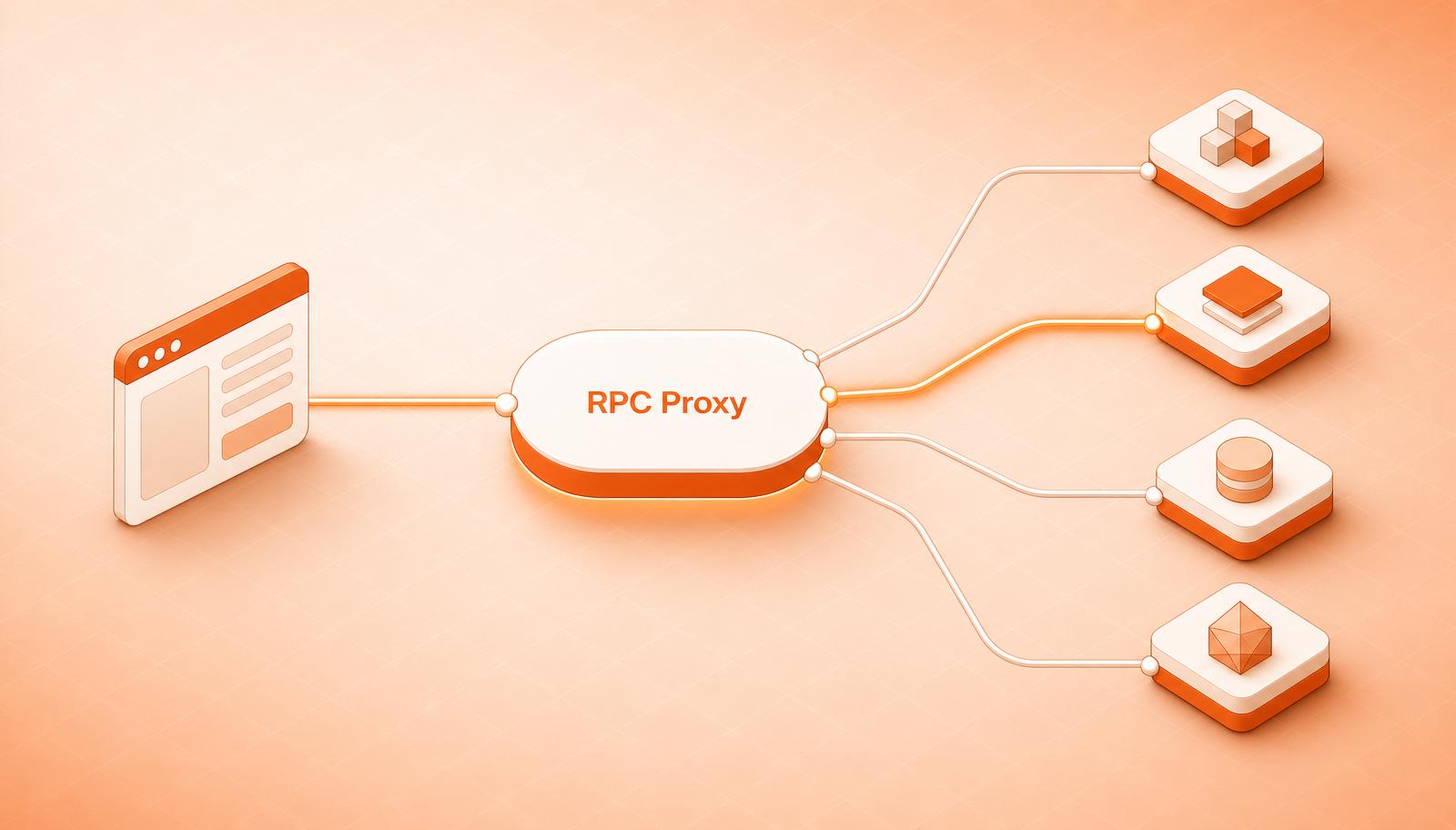
The alternative is selection based on measured quality of service. Smart Router, Magma's open-source RPC routing layer, replaces rotation with a QoS-weighted selector. Per its node selection docs, every relay flows through the same pipeline:
- A chain parser identifies the request's category: latest-state vs. archive, heavy vs. light.
- The pool is narrowed to upstreams that actually support the required API interface and category.
- Each remaining candidate is scored on three signals: latency (recent observed response times), sync (how close the node is to the chain head), and availability (recent error and timeout rates).
- A weighted-random pick is made from those scores, with a configurable minimum-selection floor so every healthy node stays in rotation and keeps producing fresh measurements.
The scores are built from recent measurements, so a provider that degrades starts losing traffic as its numbers slip rather than after an on-call engineer notices.
Which signal dominates is configurable per workload through a --strategy flag. The default balanced strategy weighs latency, sync, and availability together. A latency strategy suits user-facing reads where response time is everything; sync-freshness suits indexers and mempool watchers that can't tolerate lag; cost routes high-volume, non-critical traffic to the cheapest upstreams; distributed spreads load to avoid hot spots. The underlying score weights can also be tuned directly with --qos-* flags, and a single request can bypass the optimizer entirely with a header when you need to pin it to a specific node.
That is RPC node selection as an active, per-request decision. The remaining pieces handle what happens around it.
Integrity checks: skip out-of-sync nodes before they're picked
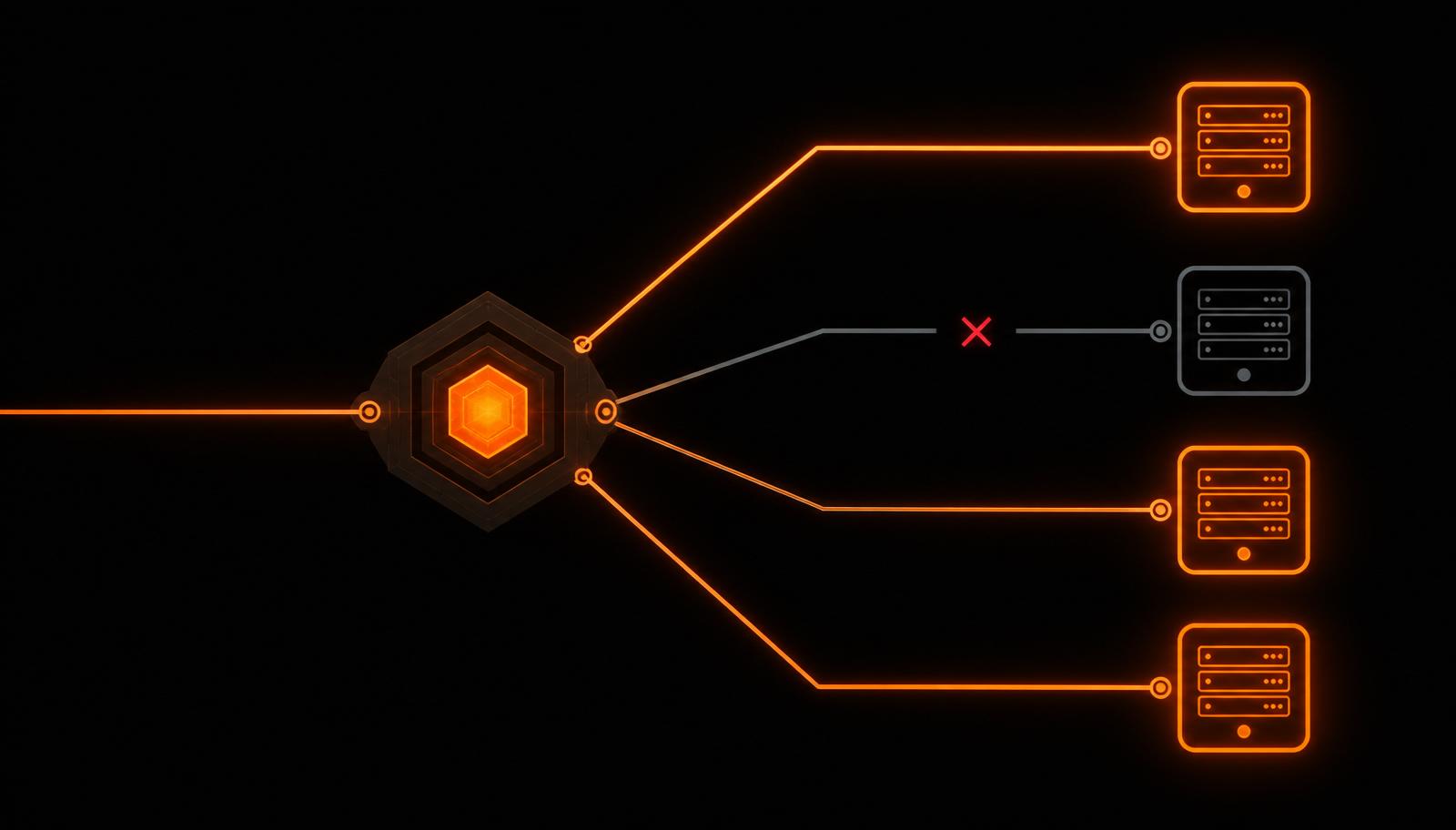
Selection scoring reacts to a node's history. The integrity check acts before the request is sent: a pre-request lag check compares each candidate node against the chain head, and nodes lagging past a threshold are skipped for that relay entirely. The threshold is derived from the chain's spec (block time and finality characteristics differ between, say, Ethereum and Solana), so "too far behind" means something appropriate for each network.
This is the mechanism that closes the silent-staleness hole round-robin leaves open: an out-of-sync node never gets the request in the first place, rather than serving stale data until an external health check flags it.
When the picked node still fails: retry, hedge, circuit breaker
Even a well-chosen node can fail mid-request. The failover pipeline composes three more policies around every relay:
Retry. If the upstream returns a retryable error, the request rotates to a different node instead of surfacing the error to your app. The limit is configurable (--set-relay-retry-limit, default 2), and an error-classification registry distinguishes retryable failures from terminal ones, so a request that can't succeed anywhere doesn't burn attempts.
Hedge. If a response hasn't arrived within a tick (derived from the chain spec), a parallel attempt fires to another node and the first response wins. Hedging converts a slow node's tail latency into a second node's normal latency, at the cost of some duplicate upstream calls.
Circuit breaker. When the pool is genuinely exhausted, the circuit breaker trips the relay early instead of retrying forever. Failing fast with a clear error beats holding a connection open through a hopeless retry loop, both for your app's behavior and for the upstreams already under stress.
An overall processing timeout wraps the whole pipeline, and per-attempt timeouts bound each individual try, so latency stays predictable even while retries and hedges are in flight.
A plain reverse proxy vs. a routing layer
It's worth being precise about the gap. nginx or HAProxy in front of RPC endpoints gives you rotation, basic liveness checks, and connection handling. What it lacks is chain awareness: it can't score nodes on sync status, exclude lagging nodes before a request, route by method category, retry or hedge a relay against other upstreams, or tell whether a response is correct.
As the Why Smart Router page puts it, RPC proxies have been built in-house thousands of times, along with the failover, caching, and monitoring around them. Smart Router is that layer as a standard, actively maintained component: failover that triggers when an upstream is unavailable, errors, returns stale data, or times out; optional cross-validation that requires multiple nodes to agree before a sensitive read is returned; block-aware caching; and Prometheus metrics plus OpenTelemetry traces across the full request lifecycle, so you can see every routing decision. It is provider-agnostic and sits in front of the endpoints you already use, whether commercial providers or self-hosted nodes.
You can build the same thing internally, and some teams should. The trade-offs of maintaining chain specs, error taxonomies, and scoring logic across every chain you support are covered in build vs. buy for the RPC routing layer. Either way, the bar for production RPC infrastructure is the same: selection based on measured health and freshness, not blind rotation. The cost of settling for less shows up as real business impact during exactly the moments your traffic peaks.
Frequently asked questions
What is RPC load balancing? RPC load balancing is distributing blockchain RPC requests across multiple nodes or providers rather than a single endpoint. For blockchain traffic, effective load balancing also requires selecting nodes by measured health, latency, and sync freshness, because RPC nodes routinely fall behind the chain head or degrade without going fully offline.
Why doesn't round-robin work for RPC endpoints? Round-robin sends each node an equal share of traffic regardless of its state. A node that is lagging behind the chain head still returns valid-looking responses with stale data, so round-robin keeps routing to it. Effective RPC load balancing needs chain-aware signals: sync status against the head, per-node latency and error rates, and checks that exclude out-of-sync nodes before they are picked.
Can I load balance RPC endpoints with nginx or HAProxy? You can, and it will spread volume and drop fully dead endpoints. What a generic proxy can't do is score nodes on sync freshness, skip lagging nodes pre-request, retry or hedge failed relays against other upstreams, or validate response correctness. Those require a chain-aware routing layer, whether built in-house or run as a component like Smart Router.
Smart Router is open source. You can run it with Docker Compose in front of your existing providers this afternoon, or talk to us about the enterprise edition.
Sources: Smart Router documentation; RPC node selection; Failover & retry.
How exposed is your RPC stack?
Take the 2-minute Secure RPC Assessment and get a personalized risk report.
Run the assessment