
RPC failures are often treated as engineering problems. That is too narrow.
When RPC fails, the impact can quickly move beyond the infrastructure team. Users may see incorrect balances. Transactions may appear stuck. Withdrawals may be delayed. Support tickets may increase. Internal teams may lose confidence in the system. Customers may question whether the product is reliable.
In blockchain products, infrastructure problems become trust problems very quickly.
Why RPC matters to the business
RPC is the connection between your application and blockchain data. If your application needs to check a balance, confirm a transaction, read contract data, or submit a transaction, it usually depends on RPC.
That means RPC sits directly underneath many user-facing and business-critical flows. When it works, nobody notices. When it fails, everyone notices.
Impact 1: Failed or delayed transactions
One of the most obvious impacts is transaction disruption. If the RPC layer is unavailable or unreliable, users may not be able to submit transactions properly.
Even worse, they may not understand what happened. Was the transaction submitted? Did it fail? Is it pending? Should they try again?
Confusion around transaction state creates support load and user anxiety. For financial products, that anxiety matters.
Impact 2: Incorrect or delayed balances
If RPC data is stale or inconsistent, balances may appear wrong or delayed. This is one of the fastest ways to damage user trust.
A user may tolerate a slow page. They will not easily tolerate a financial balance they do not trust. For exchanges, custodians, wallets, and DeFi products, balance accuracy is not a feature. It is the foundation of the user experience.
Impact 3: Withdrawal and deposit issues
Deposits and withdrawals are especially sensitive. If RPC problems affect transaction detection or confirmation logic, users may experience delayed deposits, stuck withdrawals, or unclear transaction status.
Even if funds are safe, the perception can be damaging. Users do not separate backend infrastructure from product reliability. To them, the platform is either working or it is not.
Impact 4: Higher support burden
When RPC issues reach users, support teams pay the price. They need to answer questions like:
- Where is my transaction?
- Why is my balance wrong?
- Is my withdrawal stuck?
- Should I submit again?
- Is the platform down?
Support teams often do not have enough infrastructure visibility to answer these questions clearly. That leads to slower responses, frustrated users, and more internal escalation.
Impact 5: Emergency engineering work
RPC incidents pull engineers away from planned work. Instead of building product, they investigate providers, review logs, change configurations, respond to internal pressure, and try to stabilize the system.
This has a real cost. The visible cost is the incident. The hidden cost is lost roadmap momentum. A team that repeatedly fights infrastructure fires will move slower than a team with a resilient foundation.
Impact 6: SLA and customer risk
For companies serving institutional customers, infrastructure issues may create contractual or relationship risk. Customers expect reliability. Partners expect operational maturity. Internal stakeholders expect clear incident response.
If RPC is a hidden dependency with limited redundancy and weak monitoring, it becomes hard to defend the architecture during serious reviews. Enterprise customers do not want to hear that a critical flow depends on one provider and manual intervention.
Impact 7: Reputational damage
In blockchain, trust is fragile. Users are already sensitive to risk. They worry about funds, transactions, hacks, outages, and protocol failures.
A visible infrastructure issue can create doubt quickly. Even when the root cause is a third-party provider, users often blame the application they interact with. That means your RPC provider's issue can become your brand issue.
The mistake: treating RPC as a backend detail
The biggest mistake is assuming RPC is only an engineering concern. It is not.
RPC affects user experience, trust, support workload, incident response, customer commitments, product reliability, engineering velocity, and vendor risk. That makes it a business issue.
What good RPC risk management looks like
A stronger RPC strategy includes several layers:
- Redundancy - Do not rely on one provider for critical flows.
- Automatic failover - Move traffic away from unhealthy providers quickly.
- Performance-aware routing - Route based on latency, reliability, and provider behavior.
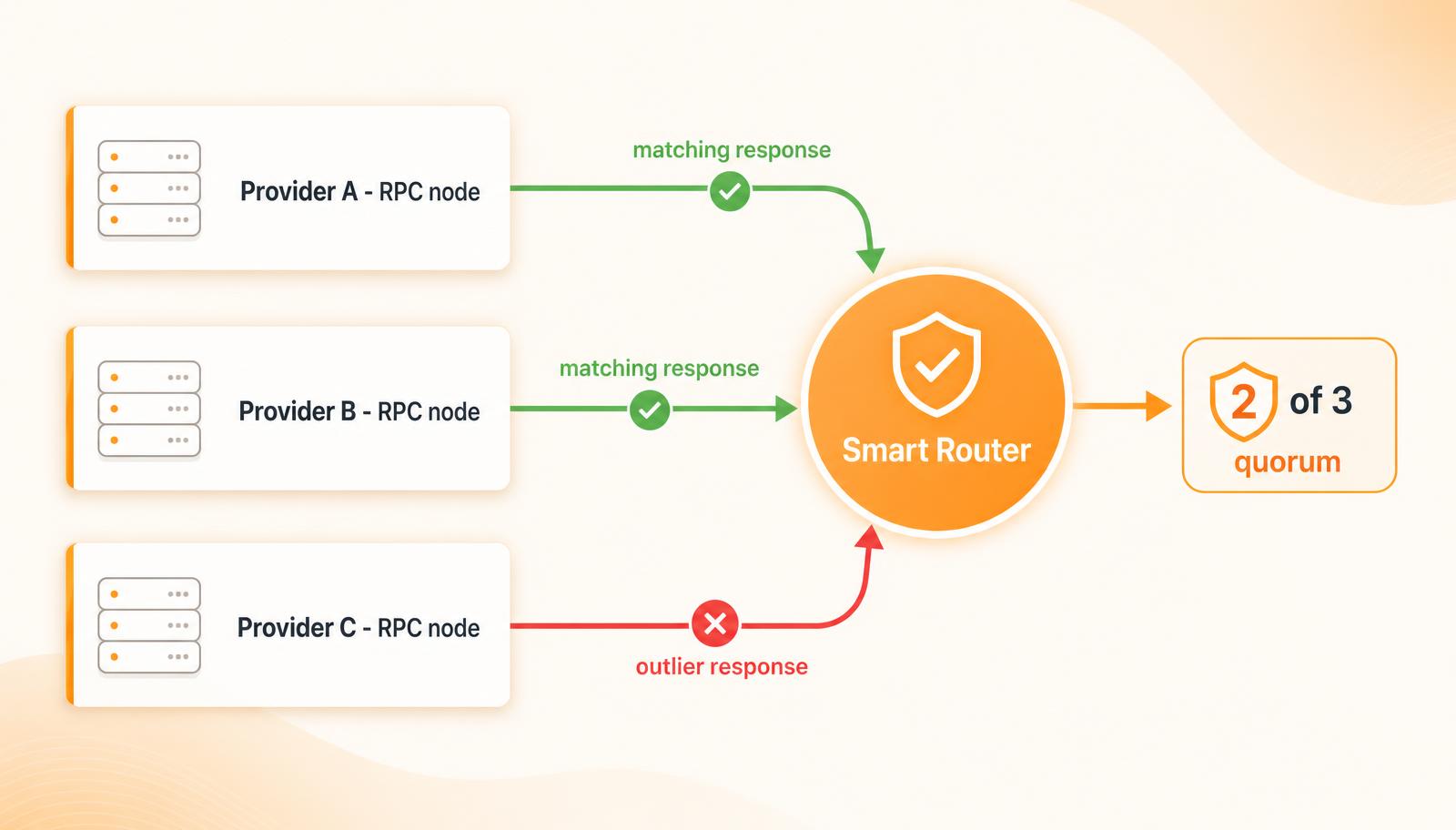
- Validation - Detect when providers return inconsistent or questionable data.
- Observability - Know which provider, chain, method, and flow is affected.
- Operational ownership - Make sure someone clearly owns the RPC layer and its reliability.
Where Smart Router fits
Magma's Smart Router helps teams reduce RPC-related business risk by turning RPC into a managed reliability and security layer.
Instead of relying on one provider or internal fallback scripts, Smart Router helps teams route across providers, fail over automatically, validate responses, and understand provider behavior.
The result is not just better infrastructure. It is fewer avoidable incidents, faster recovery, clearer visibility, and stronger customer confidence.
The bottom line
RPC failures do not stay inside the engineering team. They affect users, support, customers, reputation, and revenue.
For serious blockchain companies, the question is not whether RPC deserves attention. The question is whether your current setup is strong enough for the level of trust your product requires. If the answer is unclear, that is already a signal.
How exposed is your RPC stack?
Take the 2-minute Secure RPC Assessment and get a personalized risk report.
Run the assessment